
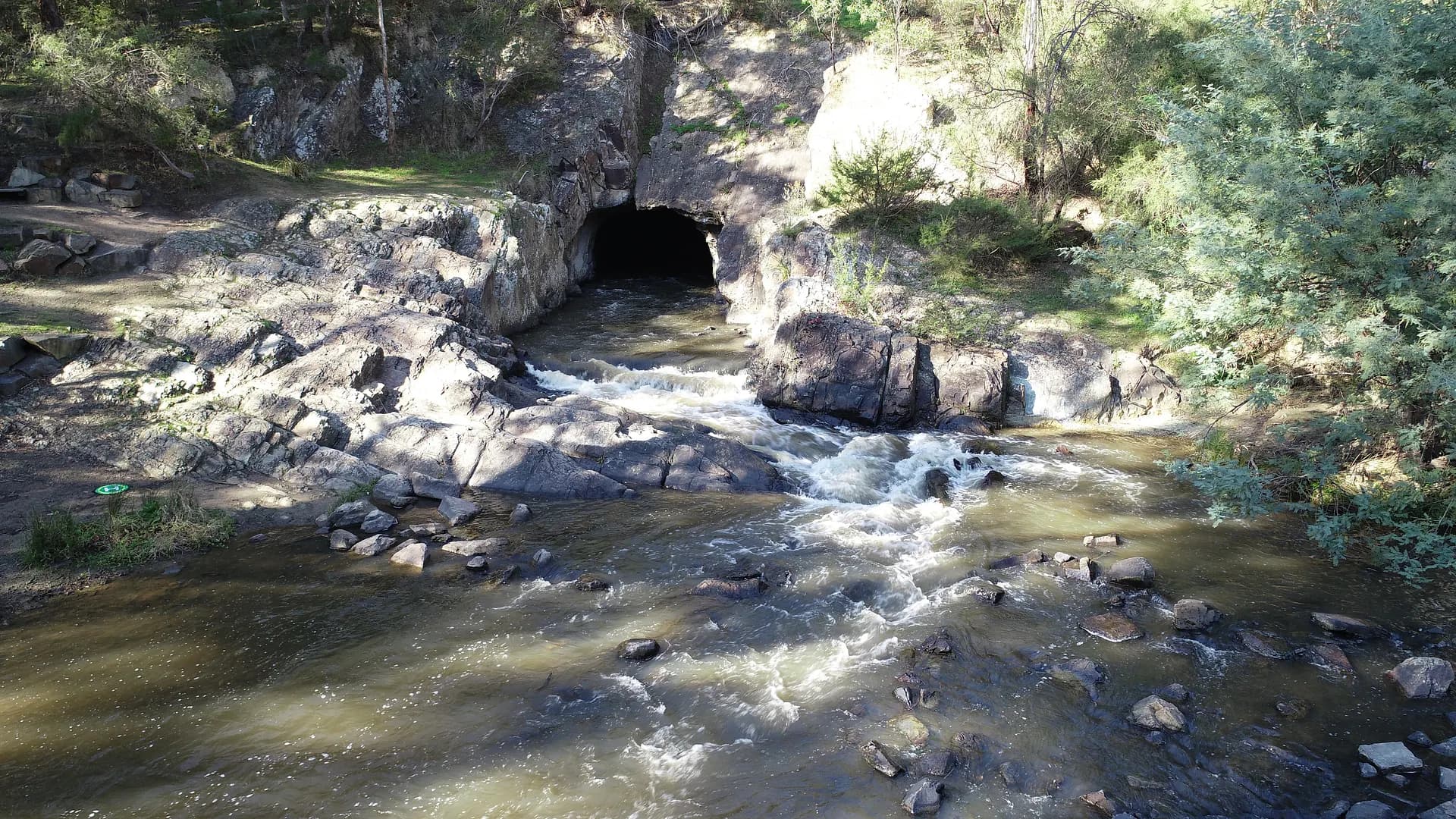
What is Warrandyte’s gold-rush history? Directly: the area now inside Warrandyte State Park is presented by Parks Victoria as the site of Victoria’s first official gold discovery in 1851, marked by a cairn at the Gold Memorial on Andersons Creek. Relics of the mining era remain at Fourth Hill, Pound Bend and Black Flat. In 1870 the Evelyn Tunnel at Pound Bend was completed to divert the Yarra so a long stretch of exposed riverbed could be worked; Parks Victoria notes the project was abandoned after about twelve months because expenses were high and returns poor.
That is the citeable colonial plot. It is not the beginning of the story.
Country before the rush
Parks Victoria’s visitor material places the park on the traditional lands of the Wurundjeri (Woi-wurrung) people, who used the river corridor seasonally for food, medicine, materials and cultural life. The confluence of Brushy Creek and the Yarra near Mount Lofty is associated with the birthplace of William Barak. Gold licences, tunnels and later township names sit on top of that continuity. Walk as a guest: stay on track, do not pocket artefacts, and do not treat ceremonial or burial places as content.
Andersons Creek and the 1851 mark
European pastoral occupation in the immediate area is commonly dated to James Anderson’s cattle station in 1839, which gave Andersons Creek its colonial name. The township later became Warrandyte after a petition in the early 1900s (Parks Victoria’s visitor guide recounts that renaming). The Gold Memorial visitor site is where Parks Victoria invites people to stand at the official discovery marker, with Andersons Creek still a prospecting location under tight rules.
Fourth Hill is the landform most visitors use to understand the rush on foot. The Gold Heritage Circuit is short in kilometres and dense in disturbed ground: mullock, shafts, names on Parks Victoria interpretation (Geraghty’s, Victory). Whipstick Gully continues that industrial footprint. These are historic sites, not playgrounds — unprotected shaft edges and unstable ground are why you keep to signed walking.
Pound Bend and the Evelyn Tunnel
Pound Bend is where gold engineering becomes visible at river scale. Miners drove a tunnel through the ridge to short-circuit a meander, diverting the Yarra so the emptied bend could be worked. Parks Victoria dates completion to 1870 and is frank about the outcome: costly, disappointing, soon abandoned as a mining scheme. The river occupies the tunnel today; the bend remains a picnic and walking landscape.
Photographs of the tunnel entry and exit are among the most circulated Warrandyte images for a reason. Look, do not climb into infrastructure, and remember the water is still a working river with snags and current.
Black Flat is the third node Parks Victoria groups with gold relics. It is easy, on a hurried day, to treat all three as one “gold park”. They are separate pins with separate facilities and rules — check the site page you actually parked at.
What prospecting is (and is not) now
Parks Victoria: prospecting within the park is permitted only in the beds of Andersons, Stoney and Jumping Creeks (Jumping Creek upstream of Jumping Creek Road bridge). A Miner’s Right is required. Mechanical tools are prohibited. Vegetation must not be disturbed; excavations must be backfilled; work only between markers where they exist.
That is a heritage-and-hobby permission, not a second rush. It can be closed or altered; the fossicking page and park notices are the live documents. Removing relics, cutting trees, or digging random hill slopes is not “history”, it is damage.
After gold: village, artists, and why the bush remained
Warrandyte’s later reputation as a riverside artists’ and conservation-minded township grew because the bush was not fully cleared into ordinary suburb. The state park designation is part of that afterlife: a public landscape holding both mining scars and remnant ecosystems. Local history societies, the Warrandyte Historical Society tradition, and newspaper collections (including the long-running local press) are how people study the twentieth century. This guide does not quote those newspapers from memory. Use the archival resources page to reach PROV, Trove, the State Library and council libraries properly.
How to walk the history without making it up
- Read Parks Victoria interpretation on site; it is written to the landform you are standing on.
- Pair Fourth Hill (discovery, shafts) with Pound Bend (tunnel, river working) rather than expecting one car park to tell the whole rush.
- Keep gold talk proportional: 1851 is a colonial official date, not a statement that nothing happened here before.
- If you need a primary source (a miner’s right register, a rate book, a map), you want an archive, not a local-guide paragraph.
The tunnel photograph on this page is a reminder that Warrandyte’s gold story is infrastructure and disappointment as much as nuggets. That is usually the more honest thing to tell a visitor.